

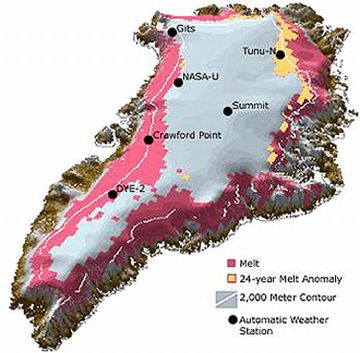
It seems, the consequences of the effects of global warming on Greenland Ice Cap melting are far more serious than what was previously thought. It will not just inundate the banks and create millions of refugees across the world. Melting of the Greenland Ice Cap will affect the ocean circulation’s future stability seriously even without reaching the seas to cause deluge.
Without the need of dumping fresh water into the oceans, melting can, thus, also change ocean circulation substantially at a catastrophic magnitude.
Revealing these fearful consequences, Dr Rainer Zahn, research professor in the ICREA at the UAB Institute of Environmental Science and Technology further informed that the magnitude at which the future climate will possibly change will depend on the ocean circulation’s response to global warming. And, that too, to a large degree.
Any slight variation in ocean circulation generally leads to substantial and abrupt climate changes all over the globe.
It is because the ocean currents are responsible for distributing an immense quantity of heat across the earth, determining levels of both ‘humidity’ and ‘energy.’
Explaining the consequences, the study says,
Deep ocean sediments offer a record of ocean circulation in the past. By studying these sediments, we can see that abrupt changes in ocean circulation and the subsequent climate change are not a new phenomenon, but have happened on several occasions in the past.
When the great ice sheets covering North America and Scandinavia melted at the end of the last ice age, the subsequent flow of fresh water into the North Atlantic caused the greatest natural disturbance in ocean circulation in the last 20,000 years.
This episode provides an excellent model to examine the relation between ocean disturbance and climate instability.
To add to the fears of global warming consequences, we no longer have to wait for the melted ice from the poles to cause sea level rise, the melting itself can be devastating enough to lead oceans to trigger climate change.
Photo: aworldtowin.net