

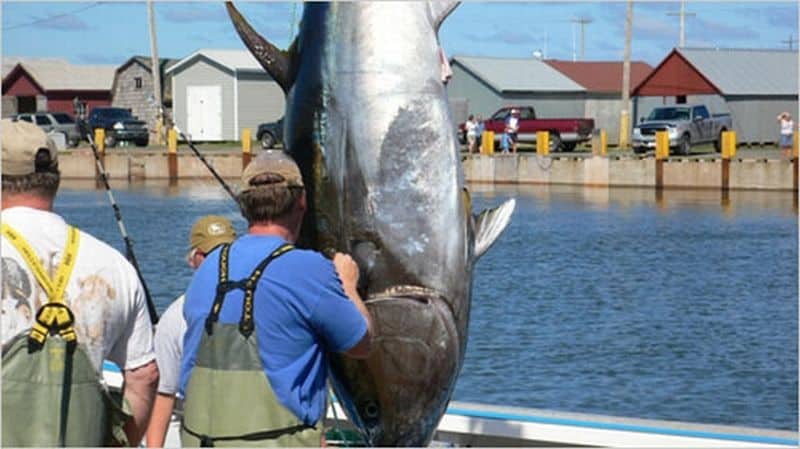
The Atlantic bluefin tuna represent yet another case of wildlife being affected by geographical borders, putting them at immense risk, wherever they go. These fishes have amazing life cycles and agile body physiology to compliment it. They undertake long migrations across the world’s oceans from where they forage to where they breed. They are threatened with overfishing practices, and illegal fishing, throughout their ranges. It has been found that the fish prefer breeding grounds where the continental shelf is steep and the temperature is between 75 – 81 ° F. This suggests that even small changes in ocean temperatures, resulting from the recent climate changes, could affect when and where bluefins breed.
Bluefin tunas are one of those unfortunate animals, whose abundance in numbers, can be estimated using ancient information from fishing practices and records. Their status, as listed by the International Union for Conservation of Nature and Natural Resources (IUCN), is ‘data deficient’ which means that there is no information on their numbers and how much damage has been done. Moreover, their range of existence is only recently being determined by periodically tagging and tracking them. It is said that most tunas are killed to provide for the ever increasing demands of ‘sashimi’ in Japan. Information on stocks per country is also controversial, since these fishes mingle across borders.
These fishes rank higher in the food chain and thus cause accumulation of heavy metals like mercury on consumption, despite this fact their population is declining. An effective and permanent ban on the trade of certain species of fish, and aquatic reptiles and mammals, would probably give them a chance for survival. They aren’t in trouble because of their bi-coastal habits, but because humans intrude with them wherever they are found.
Source: Nytimes