

Ask yourself, who do you trust with your life—a doctor’s guidance, AI data, or 1,000 strangers online? For centuries, the doctor’s word was final. Patients accepted it with little question, often seeing medicine as an act of authority rather than collaboration.
But today, healthcare operates in a very different ecosystem. Patients now stand at the intersection of three competing voices: their doctor, the AI algorithm, and the community. Each voice offers reassurance, but each also introduces doubt. Who wins this struggle for trust will shape the future of healthcare, medical travel, and wellness tourism.
Watch: The Future of Medical Tourism and Global Healthcare
The Doctor: Still the Anchor, But No Longer Alone

Consider this scenario: You are in a consultation where your doctor explains the options, and your smartwatch nods in agreement.
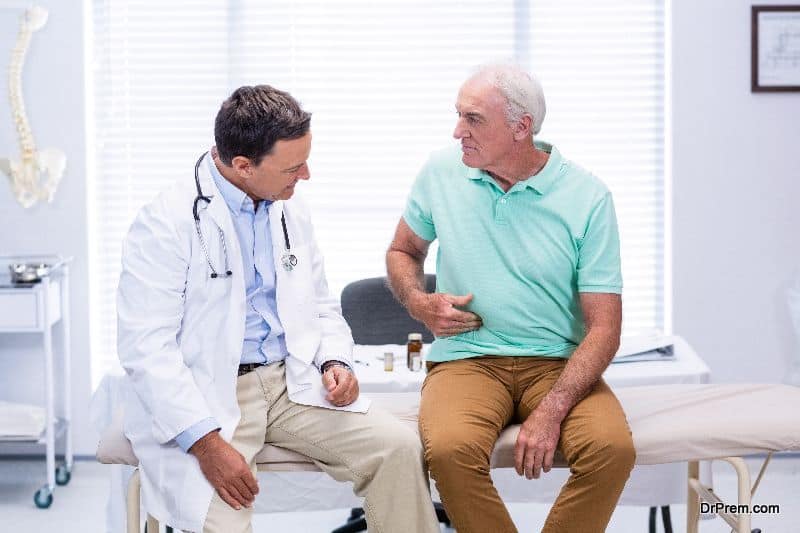
Truly, doctors remain the most trusted guides, especially when life-altering decisions are involved. In oncology or cardiac surgery, for instance, no AI or peer forum can replace the depth of human expertise and bedside manner. Yet, the monopoly of authority has weakened.
Across the world, patients often arrive at hospitals already having cross-checked recommendations on apps like Ada or Buoy. Days are not far when clinics will report patients requesting “AI-validated” second opinions before committing to procedures. It is already happening. This doesn’t reduce the doctor’s role—it redefines it. Physicians today are navigators of options, not dictators of outcomes.
Read Role of AI in Patient Care in Medical Tourism
The Algorithm: Fast, Empathetic, and Seductively Precise

Here is a surprising finding. A chatbot may not have a degree—but patients often find it more empathetic than their doctor.
AI systems promise a kind of authority rooted in data. Wearables detect arrhythmias hours before symptoms. Digital twins allow surgeons in Singapore and the U.S. to simulate procedures virtually, giving families confidence before the first incision.
At the same time, AI is not immune to risk. Patients often cannot distinguish whether advice came from a chatbot or a doctor—and may trust it equally, even when flawed.
Still, the appeal is undeniable. When the NHS integrated Wysa, an AI mental health companion, 70% of users reported reduced anxiety and depression symptoms. Algorithms are becoming the empathetic co-pilot—but one that must remain under human supervision.
Read: How AI is empowering minds
The Community: Healing Through Shared Stories
Now, another revelation: When in doubt, patients don’t always open PubMed—they open Reddit. Don’t you trust your friend’s referral while looking for the right specialist for your disease?
Communities have always shaped health choices, but digital platforms have amplified their reach. On PatientsLikeMe, 72% of members reported that peer stories helped them better understand their symptoms, while 57% gained new insights into side effects.
In medical tourism, communities wield even greater power. A traveler from Nigeria considering surgery in Thailand may trust a Facebook group of past patients more than any glossy brochure. Reddit threads on IVF or cancer care often carry as much weight as hospital websites.
This “crowd intelligence” is not always accurate, but it is deeply human. It reassures patients that they are not alone—that someone else has faced the same fear. Healing is not just technical; it is tribal.
When the Triangle Collides
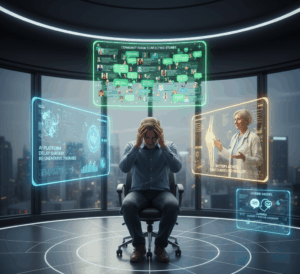
Three voices, three opinions—who do you follow when they disagree?
Imagine a patient weighing a knee replacement:
- The doctor advises early surgery for mobility.
- The AI platform suggests delaying in favor of regenerative therapies.
- The community forum is full of conflicting stories.
The patient is caught in cognitive friction. Whom do they follow? The future of healthcare depends on building transparent ecosystems where these voices complement each other instead of competing.
CataractBot, an AI system developed for eye surgery patients, demonstrates this well. It pairs chatbot advice with doctor oversight—saving time while reinforcing trust. This hybrid model shows the way forward: patients don’t want one voice silenced; they want the three aligned.
The Hidden Fourth Voice: Experience Signals

Often, the room earns more trust than the report. Trust is not only about information; it is also about the environment. A sterile waiting room versus a biophilic recovery suite can change how receptive a patient feels. Studies show that patients in naturally lit rooms required 22% less pain medication.
In medical travel, the 3-day post booking window is crucial: silence leads to second-guessing, while predictive nudges like a pre-arrival welcome video or relaxation guide strengthen confidence. Leading hospitals and wellness resorts are blending predictive hospitality with clinical care, using design and pre-engagement rituals as silent allies of trust.
Building Trust Ecosystems

The future of trust in healthcare is not about choosing one pole, but orchestrating all into a cohesive experience:
- Doctors anchor safety with expertise.
- Algorithms amplify precision with transparency.
- Communities provide emotional resonance.
- Environments reinforce confidence through design and predictive hospitality.
Trust is no longer a monopoly; it is a symphony. Those who master this orchestration will lead the next era of patient-centered healthcare.
Beyond the Triangle: Dr. Prem’s Perspective
With 25+ years of medical tourism consultancy across 78 countries, Dr Prem Jagyasi has witnessed the Trust Triangle across cultures. The pattern is the same everywhere: patients want information from doctors, validation from technology, and comfort from peers.
The winners in healthcare and wellness tourism will not be those who defend old hierarchies but those who engineer trust ecosystems. By aligning clinical, digital, communal, and environmental signals, Dr Prem’s advice helps providers transform uncertainty into confidence—and medical travel into healing journeys. Let us co-create future-ready healthcare spaces where trust is not fragmented, but multiplied. Book a session with Dr Prem Today!