
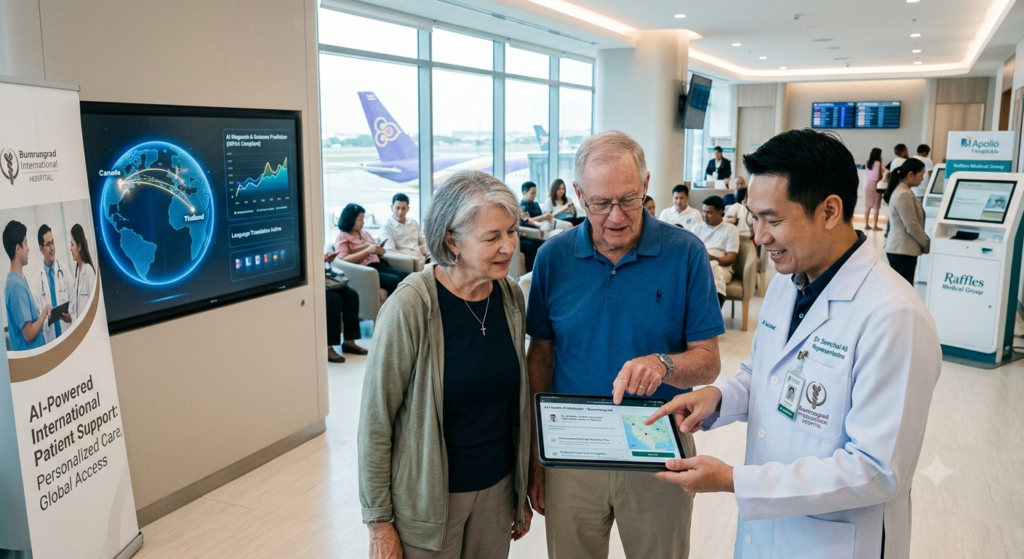
What if a patient feels foreign before ever landing in a foreign country?
That is the overlooked truth of medical tourism. A patient becomes foreign the moment they send reports to an unknown hospital, wait for a reply in another time zone, try to understand unfamiliar medical language, explain a foreign quotation to family, and imagine recovery far from the people who usually protect them. The flight only makes the distance visible. The feeling begins much earlier.
Dr Prem Jagyasi believes this is where AI will change medical tourism most deeply. Not by replacing doctors. Not by turning care into chatbot conversation. But by reducing the patient’s sense of foreignness through instant clarity, multilingual reassurance, remembered context, guided documentation, ethical escalation, and continuity from inquiry to recovery.
Key takeaways
- AI’s biggest role in medical tourism is not automation alone. It is reducing the patient’s feeling of being foreign, lost, or unsupported across the care journey.
- The safest AI use cases are human-led: intake, translation, document tracking, consultation preparation, reminders, recovery monitoring, and escalation.
- Hospitals that use AI to create familiarity, not just efficiency, will build stronger trust with international patients, families, facilitators, and referral partners.
The real barrier is foreignness
Medical tourism is usually described through distance, cost, quality, accreditation, access, and treatment outcomes. Those factors matter. But they do not fully explain the patient’s emotional reality.
The deeper barrier is foreignness.
Foreignness is not only geography. It is the moment a patient cannot understand the next step. It is the silence after sending reports. It is a quotation that feels like a bill instead of a care plan. It is the fear of paying into another country’s system. It is a family asking, “Are we sure?” It is the patient wondering who will answer after discharge.
AI in medical tourism is the use of intelligent systems to guide international patients through inquiry, documentation, consultation, travel, treatment, and recovery while keeping clinical judgment, consent, empathy, and reassurance human-led.
This is why AI should not be framed only as a digital tool. It should be framed as a familiarity system. Its purpose is to make the unfamiliar patient journey feel guided, remembered, translated, and safer.
McKinsey’s Q1 2024 healthcare survey reported that more than 70 percent of healthcare organization respondents were pursuing or had already implemented generative AI capabilities. Another McKinsey survey found that 62 percent of healthcare leaders saw consumer engagement and experience as one of the highest-potential areas for generative AI. For medical tourism, the strategic question is not whether AI will enter the system. It is whether AI will make the patient feel more supported or more processed.
Medical tourism is not only cross-border healthcare. It is foreignness management. The providers that win will not simply offer treatment abroad. They will make the patient feel less foreign at every step.
The patient journey starts with a trust deficit

An international patient begins with less trust than a local patient. They may not know the doctor, hospital, city, law, payment process, language, accommodation standard, food options, complication pathway, or recovery support. Every missing answer increases the trust deficit.
A domestic patient can often visit, call, return, ask a nearby doctor, or rely on local familiarity. A medical tourist must build confidence across distance.
That is why the first response matters so much. It is not administration. It is the first proof that someone is awake to the patient’s fear.
A weak reply says, “Please send reports.”
A stronger AI-supported reply says, “We have received your inquiry. Your case appears related to orthopedics. Please upload your MRI, prescription history, and recent blood reports. Your coordinator will guide the next step after doctor review.”
The difference is not technology. The difference is emotional order.
AI can acknowledge inquiries, detect language, classify specialties, identify missing documents, and alert the right coordinator. Human teams then step in with reassurance, judgment, and accountability.
Watch Dr Prem’s Insights into Patient Journey Mapping in Medical Tourism
From foreignness to familiarity

AI helps medical tourism move from foreignness to familiarity by making the patient journey clearer, faster, multilingual, better remembered, and human-led across inquiry, treatment, travel, and recovery.
Dr Prem’s fresh lens is simple: the future of AI in medical tourism is the movement from foreignness to familiarity.
This means AI should help a hospital become easier to understand before it becomes easier to sell. It should make the patient’s next step clearer before asking for commitment. It should prepare doctors better before consultations. It should help families understand the quotation before payment. It should support recovery after the patient leaves the country.
Dr Prem’s expert perspective is direct: “In medical tourism, patients do not only choose treatment. They choose the place that makes uncertainty feel manageable.”
That is the difference between AI as a tool and AI as a trust system.
Dr Prem’s Foreignness-to-Familiarity AI Framework
Dr Prem’s Foreignness-to-Familiarity AI Framework shows how hospitals can use AI without losing the human responsibility that medical tourism demands.
| Journey stage | What feels foreign | AI can create familiarity through | Human responsibility |
| Inquiry | Unknown hospital, delayed reply | Instant acknowledgement, language detection, case routing | Reassurance and ownership |
| Documentation | Confusing reports and repeated requests | Checklists, file tracking, report summaries | Medical validation |
| Consultation | Unfamiliar doctor and medical terms | Question preparation, translation support | Clinical judgment and empathy |
| Quotation | Foreign pricing and package doubts | Patient-friendly explanation | Transparency and value framing |
| Payment | Fear of sending money abroad | Secure instructions, reminders, policy clarity | Accountability and trust |
| Travel | Unknown city and logistics | Visa, itinerary, accommodation prompts | Coordinator oversight |
| Recovery | Distance after discharge | Monitoring, reminders, escalation prompts | Follow-up and medical review |
The framework protects the correct boundary. AI carries speed, memory, translation, and pattern detection. Humans carry judgment, ethics, consent, empathy, and care responsibility.
The first reply becomes the first handshake

The first reply in medical tourism is not just a message. It is a handshake across borders.
A patient may be sitting with a diagnosis in one country while a hospital team sleeps in another. In that gap, the patient searches, compares, worries, and often sends the same reports to competing hospitals.
AI can make sure the first contact is not silence. It can create a structured, respectful acknowledgement that tells the patient: you are not lost in an inbox.
This matters commercially, but it matters emotionally first. A hospital that responds with clarity reduces the patient’s sense of being foreign. It becomes psychologically closer before the patient ever travels.
The internal AI research used for this article identified a common leakage pattern in medical tourism: patients move from inquiry to response, consultation, quotation, documentation, payment, travel, and arrival, but many are lost because the journey is not managed as one system. AI can help connect that journey, but only if it is designed around the patient’s fear, not only the hospital’s workflow.
Documentation should feel like guidance, not paperwork
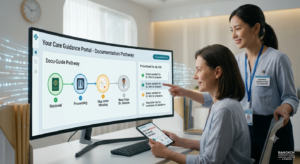
Documentation is where many patients discover whether the hospital is organized.
Reports, scans, passports, prescriptions, visa letters, consent forms, insurance details, and payment confirmations may look routine to the hospital. To the patient, they can feel like a maze.
AI can reduce this foreignness by creating one visible document pathway: what has been received, what is missing, why it matters, who will review it, and what comes next.
The purpose is not to make AI the doctor. The purpose is to prevent the patient from becoming the coordinator.
Repeated document requests are more damaging than they appear. They tell the patient that the provider may not remember them. In medical tourism, being remembered is part of being cared for.
Consultation needs emotional translation

A medical consultation across borders carries more than clinical information. It carries fear, family pressure, cultural interpretation, financial anxiety, and hope.
A 2023 JAMA Internal Medicine study found that chatbot responses to patient questions were preferred over physician responses in 78.6 percent of evaluations and were rated higher for both quality and empathy. The study does not suggest replacing doctors. It shows that AI-generated drafts may help clinicians communicate more clearly when reviewed responsibly.
For medical tourism, AI can prepare the human conversation. It can summarize the patient’s background, highlight the family’s key concern, translate questions, identify missing information, and prepare the doctor for what the patient may be afraid to ask.
A patient may say, “How many days will I stay?” The hidden question may be, “Will my family manage this?” A patient may ask, “What is the success rate?” The hidden question may be, “Can I trust you with my life?”
AI can help surface the visible question. Human expertise must answer the human fear behind it.
The quotation is where trust meets money
The quotation is one of the most sensitive moments in the international patient journey. Hospitals may see it as a financial estimate. Patients experience it as a decision map.
If the quotation only lists prices, the patient compares cost. If it explains treatment, inclusions, exclusions, stay duration, recovery timeline, payment policy, travel support, and follow-up, the patient compares confidence.
AI can help transform approved quotation templates into patient-friendly explanations. It can adapt language, identify missing next steps, and explain the package in a way that supports understanding. But humans must validate pricing, medical accuracy, consent, and ethical clarity.
Payment is where foreignness becomes real. The patient is not just sending money. They are crossing a psychological bridge into another country’s healthcare system.
A trust-building hospital does not rush this moment. It clarifies it.
Recovery can feel more foreign than treatment
What if recovery feels more foreign than the hospital itself?
This is the second overlooked reality. During treatment, the patient is surrounded by doctors, nurses, coordinators, interpreters, and hospital systems. After returning home, the patient may face pain, swelling, medication confusion, delayed physiotherapy, local doctor uncertainty, or family panic in a different time zone.
This is where AI can become a post-border safety net.
A 2024 npj Digital Medicine systematic review examined 29 remote patient monitoring studies from 16 countries during care transitions from hospital to home. It found positive impacts on patient safety and adherence, while also emphasizing that human elements remain important.
For medical tourism, this evidence matters because recovery often happens after the patient has left the destination. AI can support reminders, symptom reporting, wound-photo prompts, medication adherence, rehabilitation tracking, and escalation alerts. But the rule must remain clear: AI listens, reminds, translates, and detects. Humans diagnose, reassure, decide, and treat.
Ungoverned AI can make patients feel more foreign
AI can reduce foreignness, but careless AI can deepen it.
A patient who receives a wrong answer, a cold automated response, a misleading medical explanation, or a privacy breach will not feel supported. They will feel even more exposed.
WHO’s 2024 guidance on large multimodal AI models in health highlights risks including bias, inaccurate outputs, privacy concerns, automation error, transparency gaps, and accountability. The guidance makes one point especially relevant to medical tourism: health AI must be governed, not merely deployed.
Medical tourists are often more vulnerable than local patients. They face unfamiliar laws, language barriers, payment risk, travel stress, and limited local support. AI should therefore never promise outcomes, interpret complex reports without doctor review, pressure payment, hide uncertainty, or replace informed consent.
The more vulnerable the moment, the stronger the human escalation rule must be.
The future belongs to hospitals that feel near
The future of AI in medical tourism will not be won by hospitals with the most automation. It will be won by hospitals that feel near even when they are far away.
The patient will not remember the algorithm. They will remember that the hospital replied quickly, did not ask for the same report twice, explained the quotation clearly, prepared the family, guided the travel, supported the recovery, and did not disappear after discharge.
That is remembered care.
In Dr Prem’s view, AI should not make medical tourism less human. It should make the human touch harder to miss.
Start where the patient feels most foreign
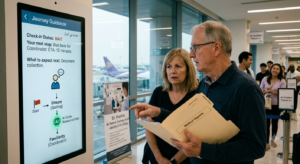
Hospitals should begin adopting AI at the point where international patients feel most confused, delayed, unsupported, or unsure about what happens next.
It may be the first inquiry. It may be a report submission. It may be a quotation explanation. It may be payment confidence. It may be discharge. It may be post-return recovery.
A practical 30-day pilot can focus on one problem: reduce response delay, reduce repeated document requests, improve quotation explanation, send recovery reminders, or create an escalation pathway for post-return symptoms.
Practical Resource: Dr Prem’s AI Patient Journey Readiness Checklist can help hospitals identify where international patients feel delayed, confused, unsupported, or foreign across inquiry, consultation, travel, treatment, and recovery.
Hospitals, clinics, facilitators, and health tourism boards can use Dr Prem’s Foreignness-to-Familiarity AI Framework to audit where patients currently wait, repeat, hesitate, disappear, or return home unsupported.
Discuss an AI-Ready International Patient Journey Strategy With Dr Prem Jagyasi
Frequently asked questions
How can AI improve medical tourism?
AI can improve medical tourism by supporting faster inquiry response, document collection, translation, patient routing, consultation preparation, quotation explanation, travel reminders, remote recovery monitoring, and follow-up escalation.
Can AI replace international patient coordinators?
No. AI should support international patient coordinators, not replace them. Coordinators provide reassurance, ownership, judgment, and cultural sensitivity. AI can reduce repetitive work and help coordinators respond faster and more consistently.
What is the safest use of AI in the international patient journey?
The safest use of AI is decision support around communication, documentation, translation, reminders, follow-up, and escalation. Diagnosis, consent, treatment decisions, and complex clinical reassurance must remain human-led.
How can AI help patients after medical travel?
AI can help patients after medical travel by sending recovery reminders, tracking symptoms, supporting medication adherence, collecting updates, enabling remote monitoring, and alerting human teams when warning signs appear.
What should hospitals measure when using AI in medical tourism?
Hospitals should measure response time, document completion, consultation attendance, quotation acceptance, payment completion, travel readiness, escalation time, follow-up completion, patient satisfaction, and unresolved concerns.
About the author
Dr Prem Jagyasi is a global medical tourism, wellness tourism and healthcare strategist. He brings 25+ years of experience, has advised across 75+ countries, and has trained 112,000+ professionals in healthcare, medical tourism, wellness tourism, and destination development.