

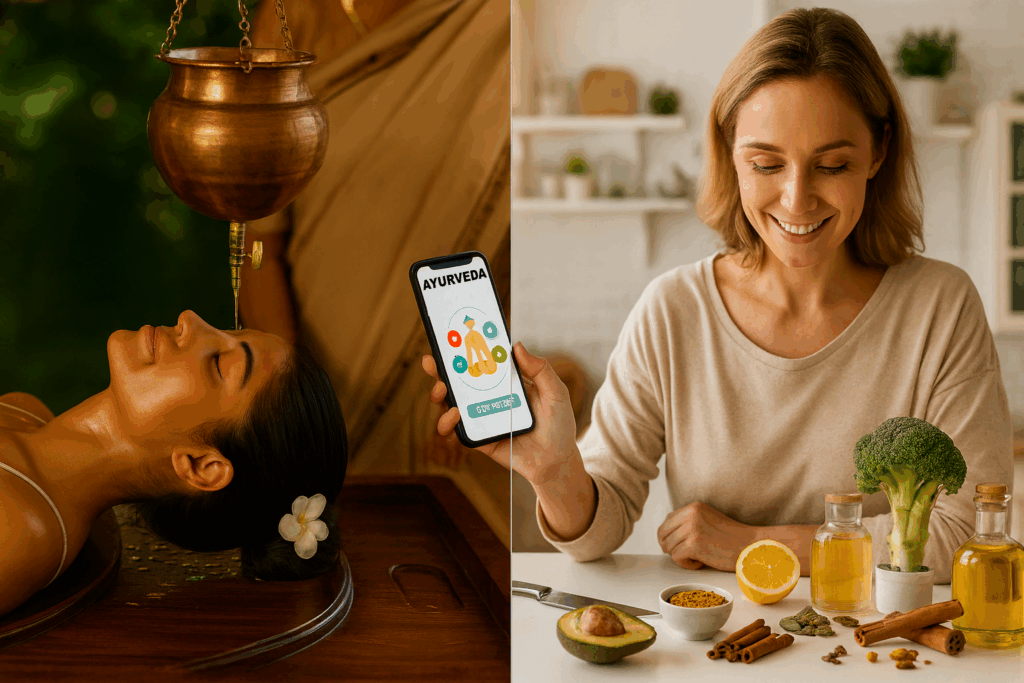
The practice of Ayurveda Tourism in India presents a dilemma because patients can receive healing treatments abroad but they can also learn Ayurvedic practices from home.
The number of tourists visiting India for Ayurveda tourism experiences has experienced rapid growth during the last ten years. People from the United States and Europe and the Middle East and Asia visit India to experience both relaxation retreats and structured healing programs and chronic condition support and detoxification plans and formal Ayurvedic education. The world recognizes India as the authentic center of Ayurvedic practice yet this does not imply that everyone needs to visit India to experience its benefits.
The current global interest in Ayurveda serves two essential objectives:
- People who visit India receive their medical care through structured programs run by trained Vaidyas (Physicians) who provide them with complete treatment plans.
- People learn Ayurveda through education to develop skills for self-care and wellness and preventive health maintenance.
The two paths offer different benefits to people who need them. People who want to decide between traveling to Kerala for healing or studying Ayurveda at home need to understand the differences between these two options.
Ayurveda for Healing: When Traveling to India Makes Sense
The medical system of Ayurveda exists in its entirety within India because the country maintains the most skilled physicians and oldest hospitals and most extensive clinical expertise. People choose to visit India because they need serious or ongoing medical treatment for their conditions.
People who benefit most from Indian medical care include those who have:
- Long-term digestive health issues
- People with autoimmune diseases
- People who experience chronic fatigue
- People who experience stress-related health problems
- People with skin conditions including eczema and psoriasis
- People with hormonal imbalances
- People who experience pain and inflammation
- People who need help recovering from illness
- People who experience burnout and exhaustion
The healing centers in India provide treatment programs that Western wellness centers lack.
India’s Healing Programs Typically Include:
- Extended treatment programs lasting 14 to 45 days
- Therapeutic environments with coordinated diet and sleep routines
- Herbs, massages, detox treatments, and meditation
- Scheduled doctor visits throughout the stay
- A complete lifestyle transformation
- Treatment plans based on Prakriti and Vikruti
- A peaceful and relaxing atmosphere
Pros of Traveling to India for Healing
- Patients receive medical care from doctors with traditional Ayurvedic training.
- The medical treatments available at Western clinics do not match the ones found in India.
- The cost of medical retreats in Western countries exceeds the prices of Indian healthcare services.
- The supervised Panchakarma detox program provides complete therapeutic benefits.
- The Ayurvedic environment offers full immersion and therapeutic impact.
Cons
- Travel duration ranges from two weeks to six weeks.
- The quality of different treatment centers remains inconsistent.
- Language and cultural differences create challenges for patients.
- Sanskrit terminology becomes overwhelming for many first-time visitors.
- Travel becomes difficult when someone is sick or inexperienced.
- The traditional Ayurvedic food will be Indian, using mainly Indian flavors.
The benefits of Ayurveda tourism become most useful for people who need extensive medical treatment, but it does not work well for regular health maintenance.
Ayurveda for Education: Learning to Apply Ayurveda in Daily Life
The need for an extensive Indian vacation does not apply to every person. Most people require Ayurvedic self-healing techniques which help them maintain better digestion and sleep quality and reduce stress and boost their energy and skin health and immune system.
Education stands as a more vital necessity than traveling for most people.
Learning Ayurveda Provides People With Important Skills:
- Creating dietary plans based on body type
- Identifying personal triggers such as food, sleep patterns, weather, and stress
- Preventing health issues before they become major problems
- Maintaining balance during stressful situations
- Using herbs and routines and meals in a purposeful way
The Main Obstacles to Ayurvedic Education
- India’s certification programs require extended Sanskrit study
- Programs last from one to six years
- They follow a medical-school structure
- Content includes anatomy, pathology, herbal medicine, and clinical practice
- Students face contradictions between different authors
- Information becomes overwhelming and hard to apply
Most people need basic practical knowledge of Ayurveda instead of pursuing medical education.
Western Alternatives to Learning Ayurveda
People who seek Western alternatives have three main options to choose from.
1. Books
Books offer affordable prices and easy reading but often present conflicting information from different authors.
2. Weekend Workshops
Workshops provide motivational content but fail to teach participants how to apply Ayurvedic principles in everyday life.
3. Online Certification Programs
These programs offer better organization but still maintain academic standards with extensive terminology and long durations.
They make it challenging for students to use their knowledge in daily routines and lack individualized tools.
The current market requires a new category which delivers practical daily-life content through visual methods without requiring complex knowledge.
The New Middle Path: Learning Ayurveda Visually, Simply, and With Technology
The solution to this problem exists through CureNatural.
Ayurveda receives its first-ever educational approach which combines visual learning with simplified explanations and technological tools.
CureNatural Makes Ayurveda Accessible Through:
- Visual methods instead of complex Sanskrit textbooks
- Easy-to-understand explanations matching contemporary learning styles
- Tools that help users discover their individual constitution
- Demonstrations of routines, food choices, herbs, and daily practices
- A mobile application with AI tools to generate personalized wellness plans
- Home-based healing plans based on Prakriti and Vikruti
- Red Light Therapy Bulbs
Swap out a standard bathroom bulb for a red light therapy bulb. It gives off a warm, low-frequency glow that supports skin health, mood, and recovery. These bulbs screw straight into normal fittings, so you get a spa-style atmosphere without any renovations. - LED Red Light Panels
These slim panels mount on the wall or sit on the vanity and provide targeted red and near-infrared wavelengths. Great for morning routines and post-training recovery. Many come with built-in timers and mobile app controls to track sessions.
Why This Matters for Global Ayurveda
Ayurveda faces long-standing challenges:
- Complex terminology
- Inconsistent teacher quality
- Insufficient visual learning methods
- Poor modern educational design
- Difficulty applying ancient principles to contemporary life
CureNatural addresses these issues by offering Western learners familiar educational structures while maintaining traditional Ayurvedic principles through technology. Users practice Ayurveda in their daily lives instead of focusing solely on theory.
Ayurveda will achieve worldwide adoption through daily self-care, extending beyond India retreats.
Choosing Healing vs Learning: Two Paths, One Goal
People should visit India for medical treatment when they need extensive or ongoing healing or supervised detoxification or clinical-grade medical care. Their stay should be between two weeks and six weeks. People who want immersion should travel to India.
People who want to learn Ayurveda for everyday health maintenance should choose home-based education. People who want to understand their body type can perform an Ayurveda dosha test, then use tools and home-based education to improve digestion, manage stress, improve sleep quality, control weight, and boost immunity. People who learn through visual methods and need structured education should choose home-based learning. People who need help managing their daily routines through modern tools should choose home-based education with CureNatural-type Ayurveda mobile app. People who want to learn Ayurveda while maintaining their current lifestyle should choose online Ayurveda courses, to apply the Ayurvedic principles to their current lifestyle.
The world will see Ayurveda evolve into multiple paths which include both Indian retreats for deep healing and contemporary learning tools for daily wellness. The two approaches maintain their essential functions which will shape the global development of Ayurveda.